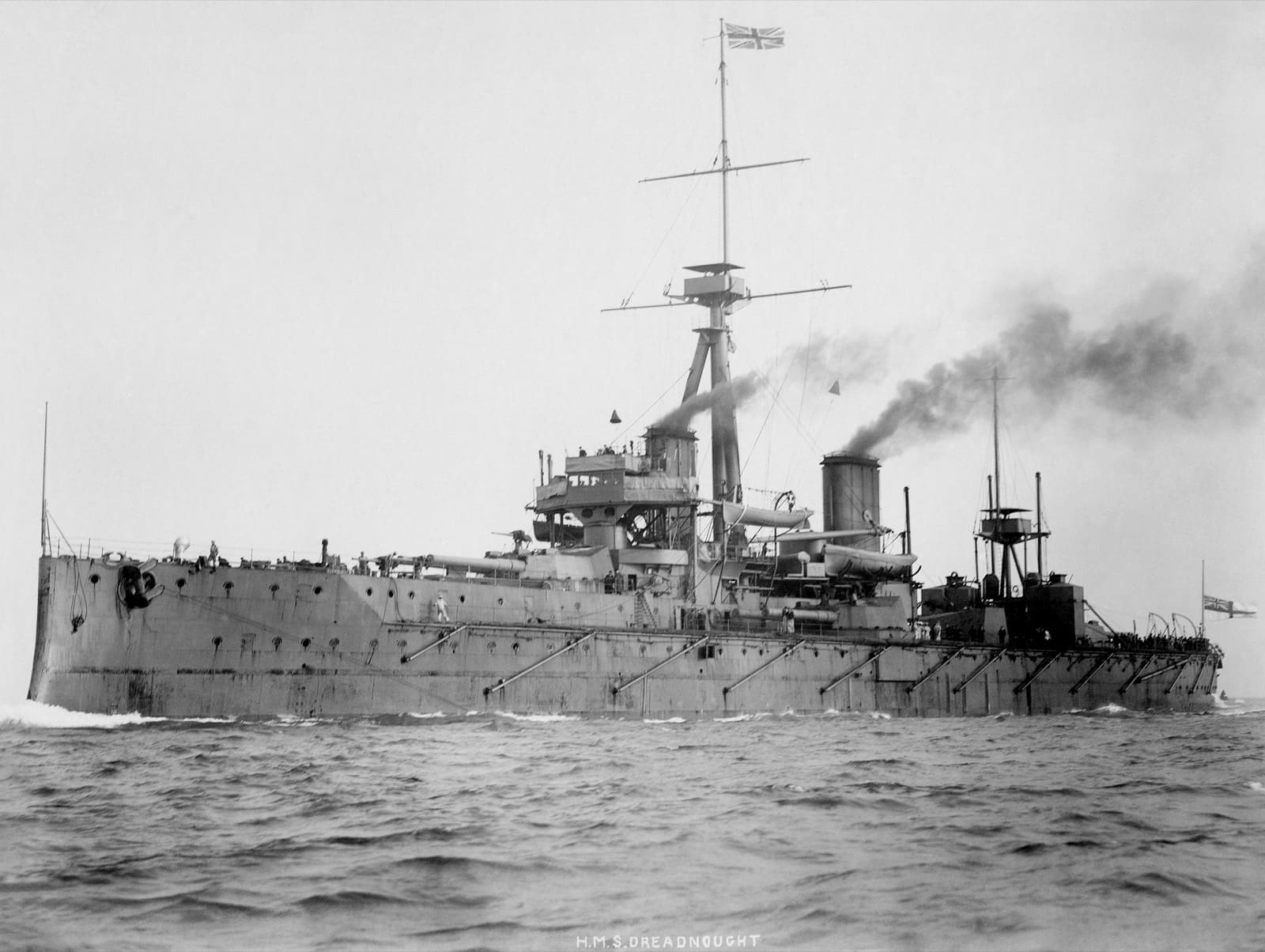
HMS Dreadnought carried ten 12-inch guns. In nine years of service, she sank one enemy vessel. She did it with her bow.
Before that, she was boarded by a party of Abyssinian princes who turned out to be a group of young Londoners in greasepaint, one of them the future Virginia Woolf.
A ship built in fourteen months
Portsmouth Dockyard laid down Dreadnought’s keel on 2 October 1905. She was launched on 10 February 1906 and commissioned on 2 December 1906. About fourteen months, start to finish, for a ship of nearly 600 feet and roughly 800 men.
The driving force was Admiral Sir John Fisher, the First Sea Lord, whose motto was “speed is armour.” His idea was simple on paper. Older battleships carried four big guns and a mix of smaller calibres that were hard to spot at long range. Dreadnought carried ten 12-inch guns in five twin turrets and almost nothing in between. At long range, every splash looked the same, so gunnery officers could correct their aim.
She was also the first battleship driven by steam turbines. Two sets of Parsons turbines pushed her 18,120 tons to 21 knots, faster than any battleship then in service.
The catch was that her own existence cancelled Britain’s lead. Every older battleship in the Royal Navy, and every one in every other navy, was now a “pre-dreadnought.” The naval race with Germany reset to zero, with Britain only one ship ahead. The word itself became a class: by 1914, navies counted their strength in dreadnoughts.
Prince Makalen’s visit
On 7 February 1910, the commander-in-chief of the Home Fleet received a telegram. It announced that “Prince Makalen of Abbysinia and suite” would arrive at Weymouth at 4.20 that day and wished to see Dreadnought. It was signed in the name of a Foreign Office official. Abyssinia was misspelled.
The sender was Horace de Vere Cole, a practical joker. He chose Dreadnought because she was the symbol of British naval power. His five accomplices were Virginia Stephen, her brother Adrian, the painter Duncan Grant, Anthony Buxton and Guy Ridley. They blacked their faces and wore theatrical robes. Virginia, the only woman, wore a beard.
The Navy put on a reception. An honour guard met the party at Weymouth. The “princes” were given a tour of the most secret ship in the fleet. They spoke an invented language, and when shown something they liked, they said “Bunga bunga!”
Adrian Stephen, posing as the interpreter, had a specific worry. Among the officers on board was Commander William Fisher, his and Virginia’s cousin. Fisher stood among the officers who greeted them and did not recognise either relative.
The bill comes due
Cole made sure the story got out. Photographs of the group in costume went to the Daily Mirror, and by 12 February the papers were full of it. Sailors heard “Bunga bunga” shouted at them in the street.
No law had been broken, and the Admiralty pressed no charges. Naval officers settled it privately: several of the men received ceremonial taps with a cane. Virginia was spared. The hoaxers became a footnote in the early history of the Bloomsbury Group.
The joke had a target. Cole had picked Dreadnought precisely because she stood for British naval might. A battleship that could outgun any ship afloat had been taken by six civilians with greasepaint and a post office.
Who looks worse in this? The Navy, for touring six strangers around its flagship on the strength of a misspelled telegram. But nobody in Weymouth that day was punished for it. The people who got caned were the pranksters.
The only kill
When the war came in 1914, Dreadnought was already outclassed by newer ships with 13.5-inch and 15-inch guns.
On 18 March 1915, the fleet was at sea off northern Scotland, near the Pentland Firth. The German submarine U-29 had just fired a torpedo at the battleship HMS Neptune and missed. Her periscope was then spotted from Dreadnought.
The U-boat’s commander was Kapitänleutnant Otto Weddigen. Six months earlier, in command of U-9, he had sunk the British cruisers Aboukir, Hogue and Cressy in a single morning on 22 September 1914, with 1,459 men killed.
According to the wreck record compiled by Lost in Waters Deep, Dreadnought was steaming at 15 knots when the periscope appeared about 1,500 yards off her port bow. She turned toward it and worked up to 17.5 knots. Nobody needed a gunnery solution. The bow did the work and cut U-29 in two.
What the lookouts saw next was a large patch of oil, air bubbles and wreckage. There was nothing to pick up. Weddigen could not get deep enough in time. All 32 men aboard the submarine died. The wreck has never been found.
The accounts don’t agree on the clock. Wikipedia’s account of U-29 puts the ramming at about 13:40. The Lost in Waters Deep wreck database puts the sighting at 12:28 and the ram at 12:35. They agree on the result: U-29 is the only submarine known to have been sunk by a battleship.
Dreadnought’s guns never fired at an enemy ship. She missed the Battle of Jutland in May 1916, the one battle her whole type was built for. Fisher’s other all-big-gun idea, the battlecruiser, traded armour for speed, and at Jutland three of them blew up. The bill for that trade was paid again in 1941 by HMS Hood. Most of the German battleships she was meant to face ended up scuttled by their own crews at Scapa Flow in 1919.
What’s left
Dreadnought was paid off after the war, sold for scrap on 9 May 1921, and broken up at Inverkeithing in Scotland from January 1923. Nothing of her survives as a museum ship.
What does survive is the photograph of the hoaxers in costume. The National Portrait Gallery in London holds a print in its collection, catalogued as “The Dreadnought Hoax” (NPG P1293).
The Imperial War Museum holds the photographs of the ship. The gallery holds the photograph of the joke. U-29 still lies somewhere off the north of Scotland, with Weddigen and his crew inside, unfound.