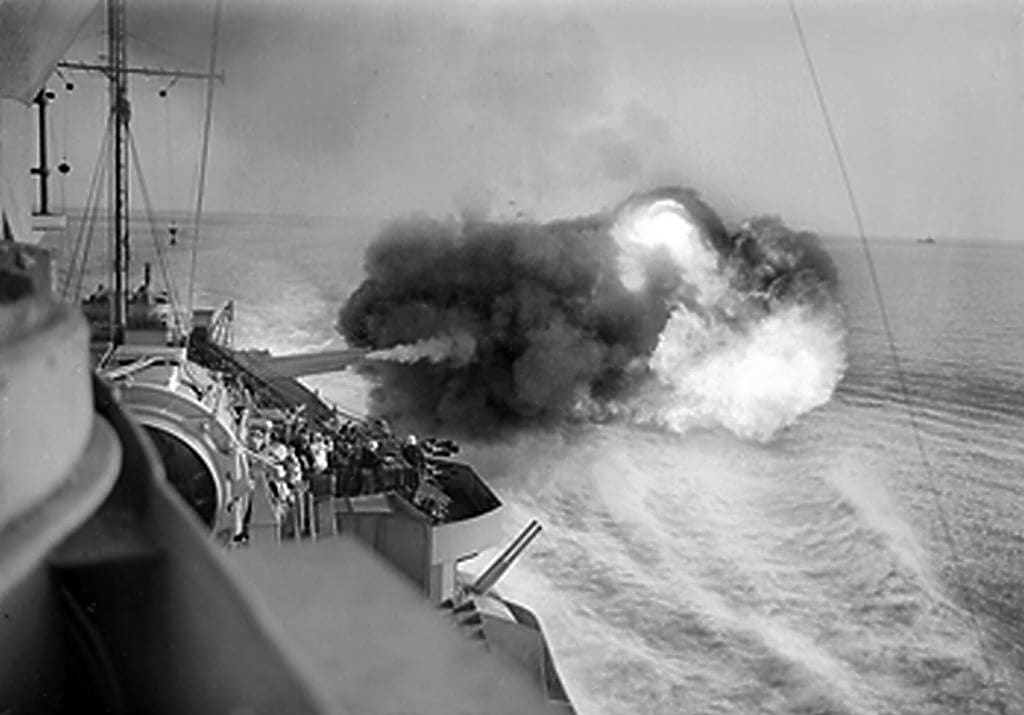
HMS Warspite was launched at Devonport Dockyard on 26 November 1913 and commissioned on 8 March 1915. She was a Queen Elizabeth class battleship: eight 15-inch guns in four twin turrets, 24 knots, oil-fired.
She fought in both world wars. The thing that finally put her out of service was a gale off Cornwall.
Two circles at Windy Corner
On 31 May 1916 Warspite was with the 5th Battle Squadron at the Battle of Jutland. Her captain was Edward Montgomery Phillpotts.
As the squadron swung round to join the Grand Fleet’s battle line, her helm jammed. The Jutland centenary project describes a bearing in the rudder gear overheating and seizing. Warspite turned toward the German High Seas Fleet and kept turning.
Phillpotts held his speed rather than stop. She completed two full circles at the point British sailors later called Windy Corner. Every German battleship in range had a target that was not going anywhere.
Sources disagree on the count. One tally gives 13 heavy hits taken during and around the circling. Another gives 15 hits from 11-inch and 12-inch shells over the whole day. The centenary project says she was holed 150 times in all.
The circling had a side effect. It pulled fire away from the armoured cruiser HMS Warrior, which was already badly damaged. Some of Warrior’s survivors believed Warspite had done it on purpose. She had not.
When the steering came back, only A turret could still fire. Warspite was ordered home to Rosyth. On the way a U-boat fired at her and missed.
She lost 14 dead. The wounded figure is 16 in one source and 32 in another. Among the wounded was Walter Yeo, later recorded as one of the first men to receive facial reconstructive surgery.
Narvik: a battleship in a fjord
On 13 April 1940 Warspite took her 15-inch guns up Ofotfjord toward Narvik in Norway, as flagship of Vice-Admiral William Whitworth. The Germans had eight destroyers in and around the harbour. All eight were sunk or scuttled that day.
Before the destroyers were reached, Warspite’s own Fairey Swordfish floatplane flew ahead to scout. In Herjangsfjord it found the U-boat U-64 on the surface near the shore and bombed her. U-64 sank.
It was the first U-boat of the war sunk by an aircraft. The aircraft was a biplane on floats, catapulted from a battleship built in 1913.
Calabria: 24,000 metres
On 9 July 1940 the British Mediterranean Fleet met the Italian fleet off Calabria, at the toe of Italy. The Italian flagship was the battleship Giulio Cesare.
Warspite opened fire at about 26,000 yards and straddled her within minutes. At around 24,000 metres one 15-inch shell hit Giulio Cesare’s after deck.
It set off ready-use ammunition for a 37mm anti-aircraft gun. Fumes were drawn down into the engine room, which had to be evacuated, and half her boilers were shut down. Giulio Cesare dropped to 18 knots. The Italians broke off the action.
It is still listed among the longest-range gunnery hits on a moving ship ever recorded. Warspite was firing from guns designed before 1914.
Salerno: the bomb that steered itself
By September 1943 Warspite was supporting the Allied landings at Salerno. On 16 September German aircraft attacked her with the Fritz X, a radio-guided armour-piercing glide bomb.
Accounts differ on the details. One says three Fritz X struck the ship. Another says two were aimed at her: the first a near miss that split her torpedo bulge, the second a direct hit that exploded in a boiler room.
They agree on the damage. The hit blew a 20-foot hole in her bottom and knocked out five of her six boiler rooms. She took on more than 5,000 tons of water. History of War puts the extra water at enough to sit her five feet deeper, and has one bomb going down through six decks before it exploded against the double hull.
The dead are given as 9 in some accounts and 12 in others. Captain Herbert Packer kept her afloat, and she was towed to Malta.
She was back in action off Normandy in June 1944, firing on German positions.
The last tow
The Admiralty decided in 1946 to scrap her. Her guns and much of her equipment came off at Portsmouth.
On 19 April 1947 she left under tow behind the tugs Bustler and Melinda III, bound for the breakers on the Clyde. On 21 April a south-westerly gale hit. Bustler’s tow parted in heavy seas south of the Wolf Rock lighthouse.
For about a day the tugs fought the weather while Warspite drifted into Mount’s Bay. Around midday on 23 April Melinda III gave up her tow. The skeleton crew dropped anchor. It did not hold.
Warspite was driven onto the Mount Mopus Ledge, about a mile south-west of Cudden Point. On the next high tide she floated off the reef and came ashore again in Prussia Cove. The Penlee lifeboat took off all seven men aboard.
A refloating attempt in 1950 used two tugs and air compressors to pump her hull. One tug ended up on the rocks and the other fouled its propeller on a hawser. After that she was cut up where she lay, a piece at a time, over the next several years.
Her crews had a name for her: the Grand Old Lady. It is carved on her memorial.
At Prussia Cove there is a memorial put up by the HMS Warspite Association and unveiled on 25 September 1992 by Admiral Sir Charles Madden. It reads, in part: “Ran aground and broken up on these rocks 1947. Her final haven. Known to all who served aboard her as the Grand Old Lady.”
For the other side of the circling at Windy Corner, start with the Battle of Jutland. For another big ship that outlived her war and still ended up on a reef, see Prinz Eugen at Bikini.