HMS Hood had a crew of 1,418 on the morning of 24 May 1941. By a little after six o’clock, 1,415 of them were dead.
The other three spent the next couple of hours in the North Atlantic holding on to floats. Then the destroyer HMS Electra came through the debris field and found them. She found nobody else.
This is about those three men: Ordinary Signalman Ted Briggs, Able Seaman Robert Tilburn and Midshipman William John Dundas. The battle itself, and what the Royal Navy did to Bismarck afterwards, is covered in the story of Bismarck’s last battle.
The ship everyone knew
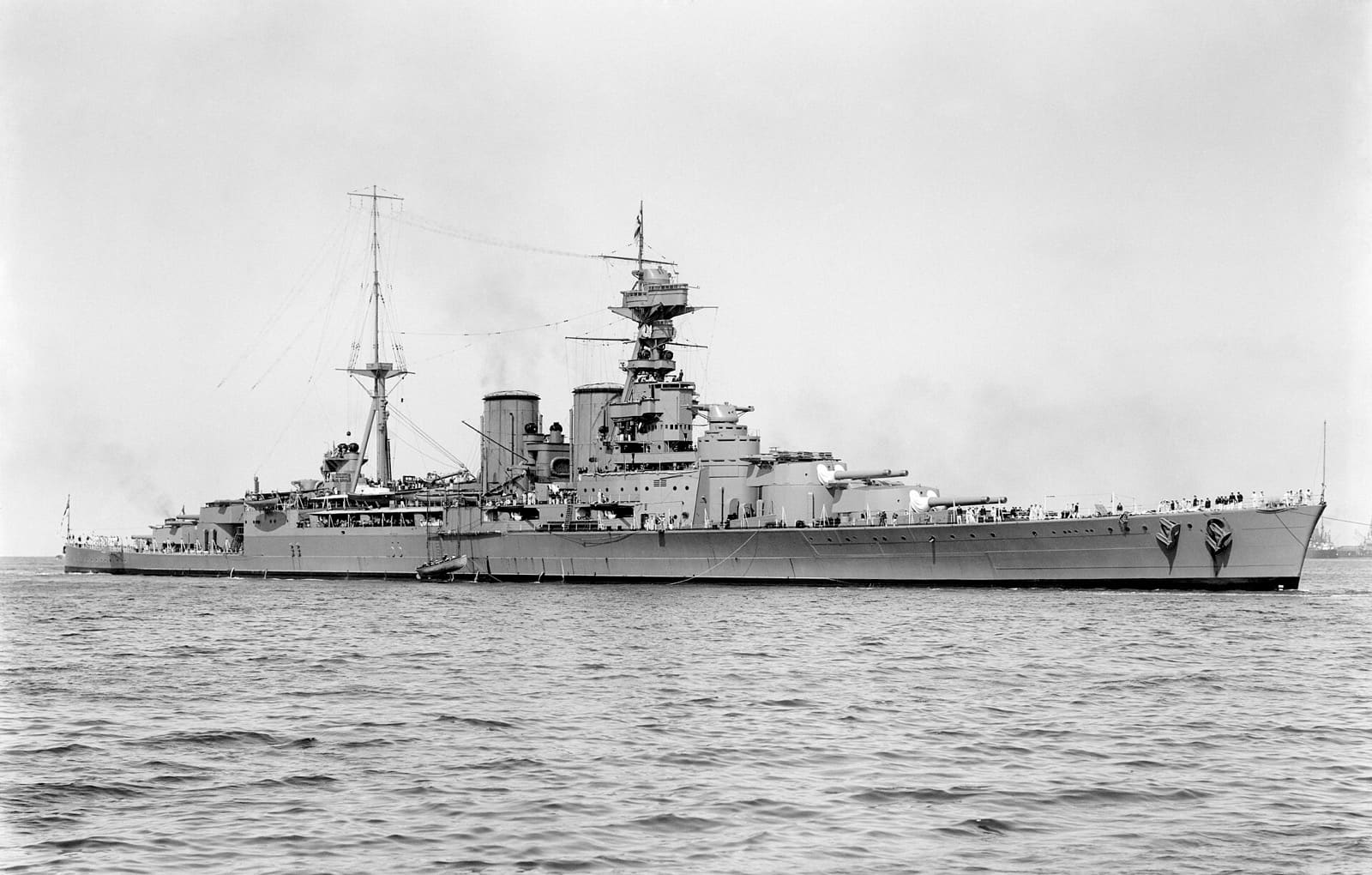
Hood was built by John Brown & Company at Clydebank, launched on 22 August 1918 and commissioned on 15 May 1920. She displaced 42,670 tons standard, carried eight 15-inch guns and made 32 knots when new. Between the wars she was the ship the public pictured when it pictured the Royal Navy.
She was also a battlecruiser, a design that traded armour for speed. At Jutland in 1916 three British battlecruisers had blown up in a single afternoon, a story told in the Battle of Jutland. Hood belonged to the same type.
Six minutes of shooting
The British sighted Bismarck and the heavy cruiser Prinz Eugen at 05:37. Hood opened fire at 05:52. The Germans replied at 05:55.
A shell hit Hood’s boat deck between the funnels and started a fire. Just before 06:00 another hit set off her after magazines. The ship broke in two. The bow rose almost vertical and went under. The whole thing took about three minutes.
Two Admiralty boards of inquiry looked at it. The first, in June 1941, concluded a shell had penetrated the magazine directly. The second, in September 1941, agreed on a magazine explosion but added that “the probability is that the 4-inch magazines exploded first.” The wreck, found in 2001 by David Mearns and Blue Water Recoveries at about 2,800 metres, is scattered in several debris fields, which fits a magazine explosion. Which magazine went first is still argued.
Three positions, three ways out
The three survivors were in completely different parts of the ship. That is the first odd thing about them.
Ted Briggs was 18 and stood on the compass platform near the bridge. He later said he did not hear an explosion. He saw “a huge sheet of flame.” The ship then rolled. When the list reached about 30 degrees he went down a ladder as B turret disappeared under the water. The suction pulled him under. He came back up, and when he looked round he saw Hood’s bow “vertical in the sea.”
Nearly everyone on that platform died with the ship. Briggs was the only one to leave it alive.
Robert Tilburn was an able seaman on one of the 4-inch anti-aircraft guns on the port side, the side facing away from the Germans. He was not doing much shooting. He watched. He remembered a shell hitting the forward shelter deck shortly after men had been ordered to take cover there, and he believed it killed about 200 of them. The two men beside him on his own gun were killed.
Then he saw the bow rise. He went into the water. The falling foremast hit him on the leg. A wire aerial caught one of his sea boots and dragged him down. He pulled out his knife, cut the boot off, and came back up.
William Dundas was a midshipman, 17 years old, the youngest of the three and the most senior by rank. How he got out is not known in any detail. His Hood Association biography says he “never spoke of his experience either in private or in public.”
In the water the three found each other on small rafts and floats. Tilburn reached them by paddling a “biscuit float.” Over the next hours Briggs and Tilburn began to give in to the cold.
Something kept them awake. Here the sources split.
The H.M.S. Hood Association’s account of Tilburn says it was Dundas who kept the other two going by singing popular songs, with Roll Out the Barrel the one usually named. Other published accounts of Briggs’s story give the job to Briggs, holding the others’ hands and singing. Since Dundas never told his side and Briggs and Tilburn told theirs many times over many decades, the version that credits the man who stayed silent is the more interesting one.
The sources also disagree on how long they were in the water. Most accounts put the rescue at about two hours after the sinking. Some versions of Briggs’s story say about three. Electra found them, plenty of wreckage and no bodies.
After
The three men attended a film premiere together in 1960, which the Hood Association believes was the last time all three were in one room.
Dundas stayed in the navy, served in the carrier Warrior during the Korean War and retired as a lieutenant commander. He later ran a mink farm in Scotland with his family. On 2 November 1965 he died in the Vale of Leven Hospital after a road accident in Argyll. He was 42.
Tilburn left the navy in 1952 and worked for the Ministry of Defence and then the Inland Revenue. He became the second president of the H.M.S. Hood Association and died on 24 February 1995.
Briggs was commissioned as a lieutenant in 1961 and retired in 1973. He was the association’s first president when it formed in 1975 and took the post again in 1995. He died in Portsmouth on 4 October 2008, aged 85. He was the last of them.
The bell
The bell was photographed on the seabed in 2001, lying away from the main parts of the wreck. A team led by Microsoft co-founder Paul Allen tried to raise it in 2012 and failed because of the weather and technical problems.
On 7 August 2015 Allen’s team went back with the yacht M/Y Octopus and a remotely operated vehicle and brought it up from about 2,800 metres, at no cost to the Ministry of Defence. Admiral Sir George Zambellas, then First Sea Lord, said it would help ensure “the 1,415 men lost, and the name Hood, will always be remembered.”
After conservation the bell was unveiled by Princess Anne on 24 May 2016, 75 years to the day after the sinking. It is on display at the National Museum of the Royal Navy in Portsmouth, the city where Briggs died. Hood is still on any list of the worst naval disasters, and the bell is the largest piece of her anyone can go and look at.