On the morning of 1 May 1915, passengers in New York opened their newspapers and found two notices printed close together.
One was a Cunard advertisement for the Lusitania, sailing that day for Liverpool. The other came from the Imperial German Embassy in Washington. It reminded “travellers intending to embark on the Atlantic voyage” that a state of war existed, that the war zone included “the waters adjacent to the British Isles,” and that “vessels flying the flag of Great Britain, or any of her allies, are liable to destruction in those waters.”
Six days later, off the south coast of Ireland, Kapitänleutnant Walther Schwieger of U-20 fired one torpedo. At 2:10 pm it struck the liner’s starboard side. Almost at once there was a second explosion. Eighteen minutes after that, the Lusitania was gone.
Most of what people argue about comes down to three items: the warning, the cargo, and that second explosion. Each has a documented core and a long tail of claims that do not hold up.
The warning was real, and it was not aimed at one ship
The German notice is often described as a threat against the Lusitania by name. It was not. The embassy submitted the warning on 22 April 1915 for publication in some 50 American newspapers. It named no ship. It ran on the morning the Lusitania sailed, which is why it is remembered next to her sailing advertisement, but the wording covered every British and Allied vessel in the declared zone.
Nobody who read it could claim they had not been told. The ship sailed anyway with 1,264 passengers, 693 crew and three stowaways, a total of 1,960 people by the most commonly cited count.
That count is not settled. Sources give the dead as anything from 1,195 to 1,201. The figure for American dead is usually 128, though PBS gives 123. This story uses “nearly 1,200,” because that is the honest range.
The munitions were real, and they were on the manifest
Germany said the Lusitania was carrying war material. Britain spent decades saying very little. Both positions contained a piece of the truth.
The cargo was not secret. The manifest filed in New York listed about 173 tons of war supplies: some 4.2 million rounds of rifle ammunition, around 1,250 cases of shrapnel shell casings, and fuses. The shells were not filled with explosive. Shipping these items on a passenger liner was legal under US law at the time.
So the munitions argument is not about whether there were munitions. There were. It is about whether they mattered to the sinking, and whether there was more aboard than the paperwork admitted.
On the second point, the evidence is thinner than the legend. The British government’s public line for years was that nothing dangerous lay in the wreck. Files released in 1982 included an internal note saying otherwise: “The facts are that there is a large amount of ammunition in the wreck, some of which is highly dangerous.” That is a real document. It confirms ammunition in the hull. It does not identify a hidden cargo of high explosive, and no diver has produced one.
Divers from the Cork Sub Aqua Club did recover rifle ammunition from the wreck in 2006, consistent with the manifest. Gregg Bemis, the American who owned the wreck, spent years trying to prove something bigger. His own conclusion, given to The Irish Times on the centenary, was that there was “still no absolute proof” of the large munitions load Germany had described.
Claims of guns mounted on the Lusitania have the same problem. She was built with fittings for twelve guns under her Admiralty subsidy, but she sailed unarmed. An armed merchant ship in a neutral American port would have been subject to internment, and nobody documented any such complaint before she left.
The second explosion is still unexplained
This is the real open question, and it is more interesting than the conspiracy versions.
Survivors described a second, heavier blast shortly after the torpedo hit. One torpedo should have holed a 31,550-ton liner with a sealed subdivision system. It should not have sunk her in 18 minutes. Something made the damage worse.
There are four main candidates.
The cargo. Robert Ballard’s 1993 expedition examined the wreck at 295 feet and found nothing to show the cargo spaces had exploded. Rifle cartridges and empty shell casings are poor candidates for a hull-splitting blast in any case.
Coal dust. Ballard’s own explanation. The torpedo likely opened one of the starboard coal bunkers, which would have been close to empty at the end of the crossing. Dust thrown into the air by the impact and touched by flame can explode. Ballard found coal scattered across the seabed around the wreck. Critics point out that bunker coal was usually too damp to make a good dust cloud.
Boilers. Cold seawater reaching hot boilers can cause a violent rupture. The Hillsdale College Churchill Project cites recent work favouring seawater hitting the boilers. Against this, survivors from the boiler rooms did not describe an explosion coming from their spaces.
A ruptured steam line. The high-pressure lines between boilers and engines could have failed violently. That would explain a loud blast and a sudden loss of power, though perhaps not major structural damage.
None has been proven. Skeptoid’s review of the evidence ends where the honest version has to end: “no source for a second explosion has ever been proven.” What can be said is that the cargo is the least supported explanation, not the most.
The conspiracy that won’t sink
The longest-running claim is that Winston Churchill, then First Lord of the Admiralty, let the Lusitania be sunk to drag the United States into the war. The usual evidence is a supposed Admiralty meeting on 5 May 1915 that produced secret orders.
The Hillsdale College Churchill Project traced that claim and found no record of the meeting, and no “Admiralty War Diary” of the kind cited. What the record does show is four Admiralty warnings about submarine activity sent to the ship before she was hit.
Captain William Thomas Turner, an experienced Cunard master who had commanded both Lusitania and Mauretania before the war, slowed down after sighting the Irish coast so he could time his arrival at Liverpool with the tide. He was also running with one boiler room shut down to save coal, which cut her top speed from about 26 knots to about 21. Admiralty guidance said to keep speed up and stay away from headlands. The Old Head of Kinsale is a headland.
That is a less exciting story than a plot in Whitehall. It is the one the documents support. If you want to compare it with another case where a single hit did outsized damage, see the loss of the Moskva in 2022, or where official accounts trailed the evidence, the Kursk.
The United States did not declare war in 1915. It took almost two more years. The Lusitania appears on lists of the worst losses at sea for her dead, not because she changed policy overnight.
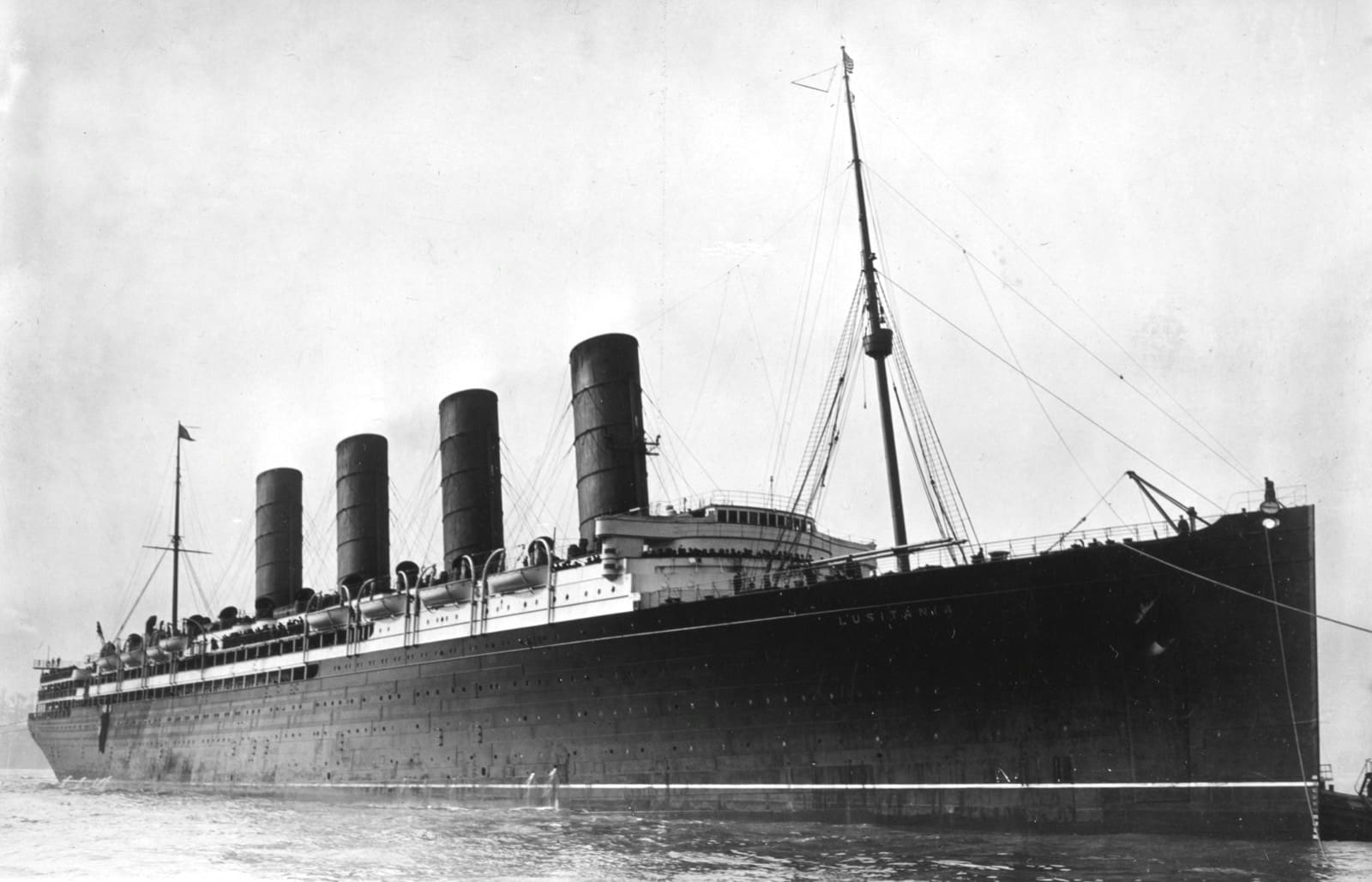
The wreck lies about 11 nautical miles off the Old Head of Kinsale, at 51°24′45″N 08°32′52″W, in roughly 295 feet of water. The cartridges are still down there, and so is the answer about the second explosion, if there is one to find.