The ship was supposed to be called Adolf Hitler.
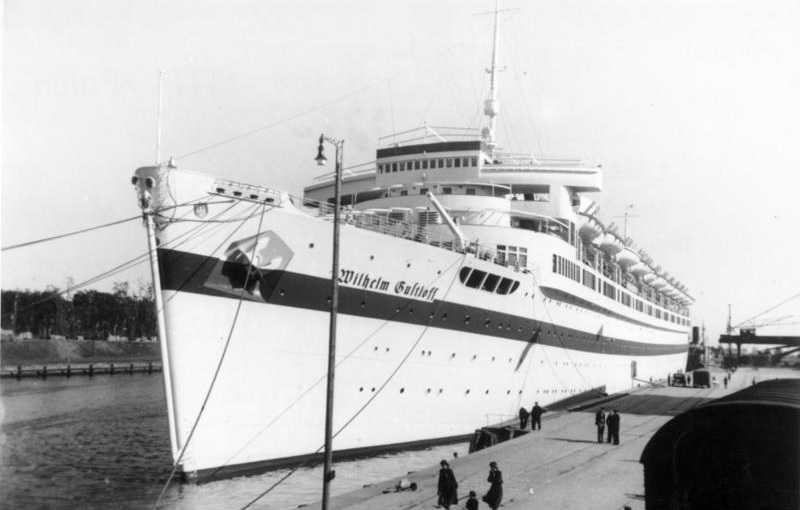
She was launched at Blohm & Voss in Hamburg in May 1937, a 25,484 GRT cruise liner for Kraft durch Freude, Strength Through Joy, the Nazi labour front’s holiday program. Then in February 1936 a student had shot Wilhelm Gustloff, the party’s man in Switzerland, and the new ship took the dead functionary’s name instead.
She was built for about 1,900 people, crew included. On her last night she carried somewhere around 10,000.
From cruise ship to barracks
The cruising lasted barely more than a year. When war came in September 1939 she became a hospital ship. From late 1940 she sat at Gotenhafen, today’s Gdynia in Poland, as a floating barracks for the 2nd Submarine Training Division.
She stayed there for four years. By January 1945 the Red Army had cut East Prussia off from the rest of Germany, and the Kriegsmarine started Operation Hannibal, a sea evacuation that pressed anything that floated into service. A liner that had not moved in years was suddenly one of the biggest lifeboats on the coast.
Refugees came aboard officially and unofficially. Many simply pushed on. Nobody agrees how many people were on her when she sailed, and that uncertainty runs through every number in this story.
Four captains, one set of lights
Wilhelm Gustloff left Gotenhafen shortly after noon on 30 January 1945. A second transport and a second torpedo boat were supposed to sail with her. Mechanical trouble took both out, and she went west with a single escort, the torpedo boat Löwe.
There were four captains aboard: the liner’s master, Friedrich Petersen, two other merchant captains, and Lieutenant Commander Wilhelm Zahn, the senior officer of the U-boat trainees. They argued. According to the most common account, Zahn wanted to hug the shallow coast with the lights out. Petersen chose deeper water that was known to be swept of mines. Other retellings reverse who wanted what, so treat the details with care.
What is not disputed is the next decision. Around 6 p.m. Petersen was told a German minesweeper convoy was coming the other way. To avoid a collision in the dark, he switched on his navigation lights.
A blacked-out Baltic, a liner the size of a city block, red and green lamps burning. Soviet submarine S-13 found her.
Three torpedoes at nine o’clock
S-13 was commanded by Captain 3rd Rank Alexander Marinesko, born in Odessa in 1913 to a Romanian sailor father. He was a good submarine officer and a bad drinker. Over New Year 1945 he had vanished ashore in Finland for several days while his boat waited for him. There was talk of trying him as a deserter. The Baltic Fleet sent him on patrol instead, and the patrol was his chance to make the problem go away.
He shadowed Wilhelm Gustloff for about two hours on her seaward side, then worked around her stern to attack from the landward side, where nobody expected it. At about 9 p.m. he fired. Three torpedoes hit the port side. A fourth stuck in its tube and had to be disarmed by his own crew.
The first hit the bow, where off-duty crew were sleeping. Watertight doors shut on them. The second struck the drained swimming pool, which had been turned into quarters for 373 young women of the naval auxiliary. Three of them survived. The third hit amidships and took out the engines, the power and the radio.
Only nine lifeboats got away. Others had frozen to their davits. The ship listed hard to port, which made the starboard boats useless. The air was well below freezing and ice floes covered the sea.
In less than 40 minutes she was on her side. About ten minutes later she was gone.
How many died
Every source agrees the answer is “more than any other ship.” They do not agree on much else.
Rescue boats pulled out roughly 1,200 people. One widely cited figure is 1,252. Other counts are lower: the historian Chris Bellamy gives 996. The National WWII Museum puts the dead at 6,000 to 9,000 and says plainly that we will probably never know how many were aboard. Heinz Schön, a Gustloff survivor who spent decades researching the passenger lists, arrived at 9,343 dead. A 2003 computer reconstruction for the Discovery Channel modeled about 10,600 aboard and 9,600 dead.
The honest range is something like 6,000 to 9,600. Even the low end is four times Titanic and five times Lusitania, which is why she sits at the top of every list of the worst naval disasters. That list also includes USS Indianapolis, torpedoed four days after delivering the Hiroshima uranium.
The other number that matters is roughly 1,000. That is about how many naval personnel, mostly U-boat trainees, were aboard, along with anti-aircraft guns. She was not marked or notified as a hospital ship. That is why most historians conclude she was a legitimate target, and why war-crime charges against Marinesko have never stuck. The National WWII Museum also notes that Marinesko did not know what he was looking at. The sinking fell, by coincidence, twelve years to the day after Hitler became chancellor.
The hero who was not allowed to be one
Eleven days later, on 10 February, Marinesko sank a second big ship, the General von Steuben, carrying wounded soldiers and refugees. Thousands more died. Between them the two liners made him the top Soviet submarine commander by tonnage sunk.
His division commander recommended him for Hero of the Soviet Union. The recommendation was cut to the Order of the Red Banner, the lesser award, partly because of his record. His next patrol, in April and May, produced no attacks at all and was rated unsatisfactory. On 31 May a report said he spent all his time drinking.
On 14 September 1945 Navy Commissar Nikolai Kuznetsov signed the order: removed from command and demoted to lieutenant for neglect of duty, heavy drinking and “domestic immorality.” He spent a month commanding a minesweeper and went into the reserve in November.
It got worse. In 1949, working as a deputy director at a Leningrad blood transfusion institute, he was sentenced to three years for squandering state property. He served it in a labour camp and was out by 1951.
In 1960 his rank was restored. He died of cancer in Leningrad on 25 November 1963, aged 50. In 1990, on the 45th anniversary of victory in Europe, Mikhail Gorbachev made him a Hero of the Soviet Union. He had been dead for 27 years.
Who carries the blame for the 9,000? Marinesko pulled the trigger on a lit, armed ship that carried a thousand servicemen. Petersen switched on the lights. The local Nazi Gauleiter, Erich Koch, had fought to postpone the evacuation. The Kriegsmarine sent a ship packed past five times her design load to sea with one escort. The Germans opened an inquiry into Zahn, and Germany collapsed before it found anything.
The wreck lies about 19 nautical miles off the Polish coast, east of Łeba. It is one of the largest wrecks on the Baltic floor and still draws treasure hunters. On Polish charts it is protected as a war grave, because most of the people who died that night are still inside.
Sources
- Wikipedia: MV Wilhelm Gustloff
- The National WWII Museum: The Sinking of the Wilhelm Gustloff
- Royal Museums Greenwich: Joy and Work, the fate of the German cruise ship Wilhelm Gustloff
- WW2 Gravestone: Marinesko, Alexander Ivanovich
- Amusing Planet: Wilhelm Gustloff, the deadliest ship disaster you never heard of