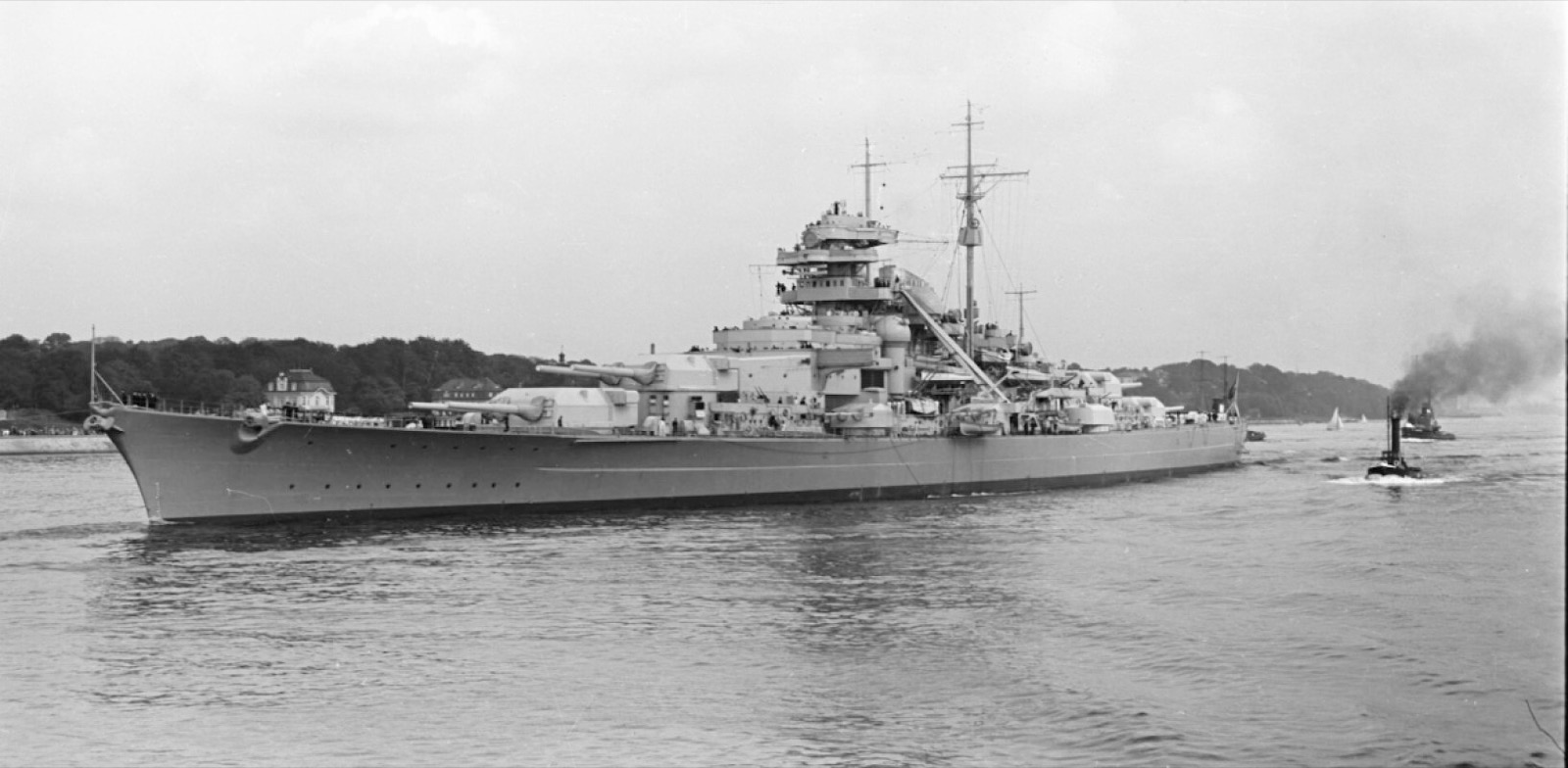
On the morning of 24 May 1941, HMS Hood fired at the German battleship Bismarck in the Denmark Strait between Greenland and Iceland. A few minutes later Hood blew up.
The forward part of the ship stayed afloat for perhaps three minutes. The stern went almost at once. The H.M.S. Hood Association puts the dead at 1,415, the largest single loss of life the Royal Navy suffered in the Second World War.
Three men came out of the water alive: Ordinary Signalman Ted Briggs, Able Seaman Robert Tilburn and Midshipman William Dundas. The destroyer HMS Electra picked them up. She found debris. She found no one else.
The association’s own account of why so few lived is blunt. There were no traces of any crewmen, living or dead, except those three. The survivors appear to have been pushed to the surface by air escaping from the sinking hull, and then reached by Electra before the cold killed them. Their survival was, by the association’s reading, mostly chance.
Bismarck had been firing at Hood for about eight minutes.
The ship that killed Hood
Bismarck was built by Blohm & Voss in Hamburg, launched on 14 February 1939 and commissioned on 24 August 1940. She displaced 41,700 tons standard and carried eight 38 cm guns in four twin turrets. On trials she made just over 30 knots.
In May 1941 she sailed into the Atlantic with the heavy cruiser Prinz Eugen, a raid the Germans called Operation Rheinübung. The plan was to hunt British convoys. Prinz Eugen would survive the war and end up as a target ship at an American atomic test, a story of its own told in what happened to Prinz Eugen at Bikini.
Bismarck did not get that far. In the same fight that killed Hood, the new British battleship HMS Prince of Wales hit her three times. One hit flooded forward compartments and cut her off from part of her fuel oil. She had to run for occupied France.
The Royal Navy, having just lost its most famous ship, sent nearly everything it had after her.
The wrong cruiser
On 26 May, British aircraft found Bismarck again, heading for Brest. The carrier HMS Ark Royal’s torpedo bombers were Fairey Swordfish: open-cockpit biplanes with fabric-covered wings.
The first strike went wrong. The crews found a large warship below the clouds and attacked it. It was HMS Sheffield, a British cruiser that had been shadowing Bismarck. According to the Navy Wings heritage flight, eleven torpedoes were dropped at her. Sheffield went to full speed and dodged the ones that reached her.
At 19:10 that evening, fifteen Swordfish from 810, 818 and 820 Naval Air Squadrons took off again. One of the pilots was Sub Lieutenant John Moffat, who later described flying straight at Bismarck through her anti-aircraft fire.
Two torpedoes hit. The second struck the stern on the port side, near the rudders. The port rudder coupling was wrecked and the rudder locked in a 12 degree turn to port.
That single hit decided the operation. Bismarck could still steam. She could not steer, and she could no longer hold a course for France. All fifteen Swordfish got back to Ark Royal.
The most modern battleship in the Atlantic had been crippled by an aircraft whose crews sat in open cockpits, on the second try of the day.
Seven hundred shells
British and Polish destroyers attacked through the night. None of their torpedoes hit.
At 08:47 on 27 May, HMS Rodney opened fire, then HMS King George V. By 10:00 the two battleships had fired more than 700 main battery shells into a ship that could not manoeuvre. Bismarck’s guns went silent. Her upperworks were wrecked. She was settling by the stern with a list to port.
She sank at about 10:40.
The number of survivors depends on which source you read. Counts of the crew run from about 2,065 to about 2,200. Most accounts give 114 to 116 survivors, most pulled out by British warships and a handful more by the U-boat U-74 and the German weather ship Sachsenwald.
Sunk or scuttled?
German survivors said the British did not sink her. They said that once the ship was beaten, the crew set scuttling charges and opened her up so she would go down on their terms.
British accounts said shells and torpedoes did it. For decades this was a question nobody could check, because the ship lay somewhere in the Atlantic, nearly five kilometres down.
On 8 June 1989, Robert Ballard, who had found Titanic four years earlier, found Bismarck. His first attempt, in July 1988, failed. The second covered some 200 square miles. The wreck sits upright at 4,790 metres, about 470 miles west of Brest. The teak planking on her deck is still largely intact.
In 2002 James Cameron took Russian MIR submersibles and small remotely operated vehicles down and filmed the hull, including the first look inside the ship in more than 60 years. His conclusion: the outer armour belt was largely unbroken, the damage below the waterline was not enough to sink her, and the crew scuttled her.
British critics did not accept that. Writing in Slate in December 2002, Mark Lewis called it an arcane dispute: Bismarck had lost the fight no matter who pulled the plug at the end. Most historians now land in the middle. The British guns turned her into a burning wreck that would have foundered. The scuttling charges probably got her to the bottom sooner.
Which is to say both sides were right, and both have spent sixty years saying the other was wrong.
What is left
Hood’s wreck lies in the Denmark Strait, where she went down in about three minutes.
Bismarck is still in the North Atlantic, upright, 4,790 metres down, with her teak deck. She is a war grave.
The total British effort to catch her came down to one torpedo from one biplane, dropped by a squadron that had attacked their own cruiser earlier the same day. For a carrier that later ran into its own command trouble, see HMS Glorious and the captain who sailed her home with no planes in the air. Hood’s loss still sits on the list of the worst naval disasters.