By December 1939, Kapitän zur See Hans Langsdorff had sunk nine British merchant ships in the South Atlantic and Indian Ocean. Total, more than 50,000 tons. Number of merchant sailors killed: zero.
He stopped ships, took the crews aboard, and sank the hulls. The captured officers he kept as prisoners later spoke well of him. For a commerce raider, it was a polite war.
His ship was Admiral Graf Spee, sister of Deutschland, one of three German “pocket battleships.” Six 11-inch guns on a cruiser-sized hull. The idea was simple: faster than anything that could sink her, stronger than anything that could catch her.
On the morning of December 13, off the estuary of the River Plate, that idea met Commodore Henry Harwood.
Three cruisers against six 11-inch guns
Harwood had three ships. The heavy cruiser HMS Exeter, under Captain Frederick Secker Bell, carried 8-inch guns. The light cruisers HMS Ajax, Captain Charles Woodhouse, with Harwood aboard, and HMNZS Achilles, Captain Edward Parry, carried 6-inch guns. Achilles was crewed largely by New Zealanders.
None of them alone could match Graf Spee. Harwood’s plan was to split up and attack from two directions, so the German gunners would have to choose.
The action opened just after 06:10. Langsdorff chose Exeter.
At 06:26 an 11-inch shell knocked out Exeter’s B turret. At 06:38 A turret went too. Her bridge communications were wrecked, fires burned below, and she took on a 7-degree list. By the end she was fighting with one turret, Y, under local control, before she limped off toward the Falklands.
The heavy fighting lasted about an hour and a half. Then Graf Spee turned west, toward neutral Uruguay, and the two light cruisers followed her at a distance.
The price on the British side: 61 killed in Exeter, 7 in Ajax, 4 in Achilles. The four Achilles dead were Ordinary Seaman Ian William Grant, 18; Ordinary Telegraphist Neville Millburn, 19; Able Seaman Archibald Shaw, 27; and Telegraphist Frank Stennett, 18. Graf Spee lost 36 men.
The hit that mattered
The cruisers had not sunk Graf Spee. They had not come close. But one 8-inch shell from Exeter went through two decks and burst near the funnel, wrecking the plant that processed her raw fuel oil. Without it, Langsdorff had about 16 hours of usable fuel. Germany was on the far side of the Atlantic.
Two-thirds of her anti-aircraft guns were gone and one secondary turret was knocked out. The ship could still steam and still shoot. She could not go home.
So Langsdorff took her into Montevideo.
The paperwork war
What followed was fought by lawyers and diplomats.
Under the 13th Hague Convention, a warship could stay in a neutral port for 24 hours, longer only for repairs needed to make her seaworthy. The Uruguayans granted 72 hours.
The British minister in Montevideo, Eugen Millington-Drake, found a second clause to work with. Article 16 said a belligerent warship could not leave a neutral port until 24 hours after a merchant ship of the enemy side had sailed. So British and French merchant ships were sent out at 24-hour intervals, each departure a small anchor on Graf Spee.
At first the British wanted her held in port. Every day she stayed was a day for help to arrive. And help was thin. Ajax and Achilles were both damaged. The heavy cruiser HMS Cumberland, which had been at the Falklands, arrived on December 14 after a long run north. That was it.
The fleet that wasn’t there
So the British invented one.
Signals went out on frequencies the Germans were known to monitor, suggesting that a much larger force was gathering: the aircraft carrier HMS Ark Royal and the battlecruiser HMS Renown. Agents spread the same story among workers on the Montevideo docks. Information was passed over telephone lines the British knew were tapped.
In reality Ark Royal and Renown were around 1,000 miles away. Waiting at sea were two bruised light cruisers and Cumberland.
Langsdorff believed it. He considered a run up the estuary to Buenos Aires, in friendlier Argentina, and ruled it out, partly because he thought Renown’s guns and Ark Royal’s aircraft stood in the way. He also had a ship he could no longer fuel properly, and a deadline.
It is easy to call him a dupe. It is fairer to ask what he could have done with 16 hours of fuel and an estuary full of shallow water, even against three cruisers. The bluff did not make his situation hopeless. It made him certain it was.
7:54 p.m., December 17
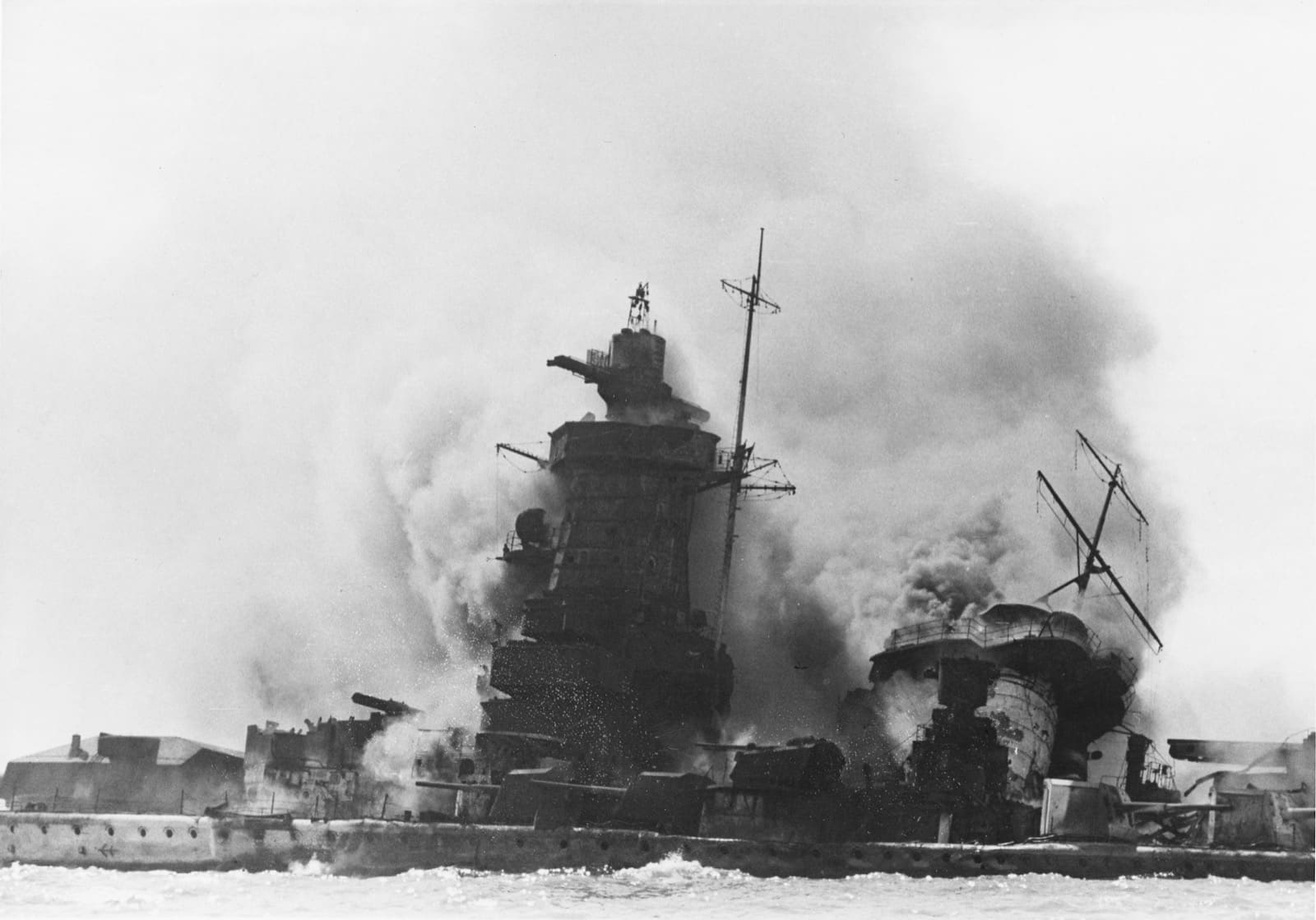
On December 17 Graf Spee left Montevideo harbour for the last time. Her crew got off. Just outside the harbour, a series of charges went off at 7:54 p.m., and she settled on the shallow bottom of the estuary, burning. The British cruisers waiting offshore never fired a shot.
The crew went to Buenos Aires. So did Langsdorff.
The ensign
On December 19, in the Naval Hotel in Buenos Aires, Langsdorff wrote his last letters. In one he said: “I alone bear the responsibility for scuttling the panzerschiff Admiral Graf Spee.” In another: “For a captain with a sense of honour, it goes without saying, that his personal fate cannot be separated from that of his ship.”
Then he lay down on Graf Spee’s battle ensign and shot himself with a pistol. He was found on December 20. He was buried in the German section of La Chacarita Cemetery in Buenos Aires.
He had kept his crew alive. He had kept the merchant crews he captured alive. The one man he did not keep alive was himself.
Achilles came home to Auckland on February 23, 1940, to a state welcome. Like the German fleet at Scapa Flow twenty years earlier, Graf Spee ended by her own crew’s hand rather than her enemy’s. Unlike Bismarck eighteen months later, she never fought her last battle.
What is left
The wreck still lies in shallow water off Montevideo, slowly being taken apart.
A 150mm gun mount was raised in 1997 and restored. Her 27-ton gunnery control station came up on February 25, 2004. On February 10, 2006, salvors lifted the bronze eagle from her stern, 2 metres tall and about 400 kg.
Her rangefinder is on display at the National Maritime Museum in Montevideo, a few miles from where she sank. The three Achilles sailors buried ashore lie in the British Cemetery in the same city. The German dead are in the Cementerio del Norte.
Sources
- Wikipedia: Battle of the River Plate
- National Museum of the Royal New Zealand Navy: The Battle of the River Plate
- Royal Museums Greenwich: The German pocket battleship ‘Admiral Graf Spee’ in 1939
- History Hit: The Battle of the River Plate
- HMS Ajax and River Plate Veterans Association: Crew and Casualties