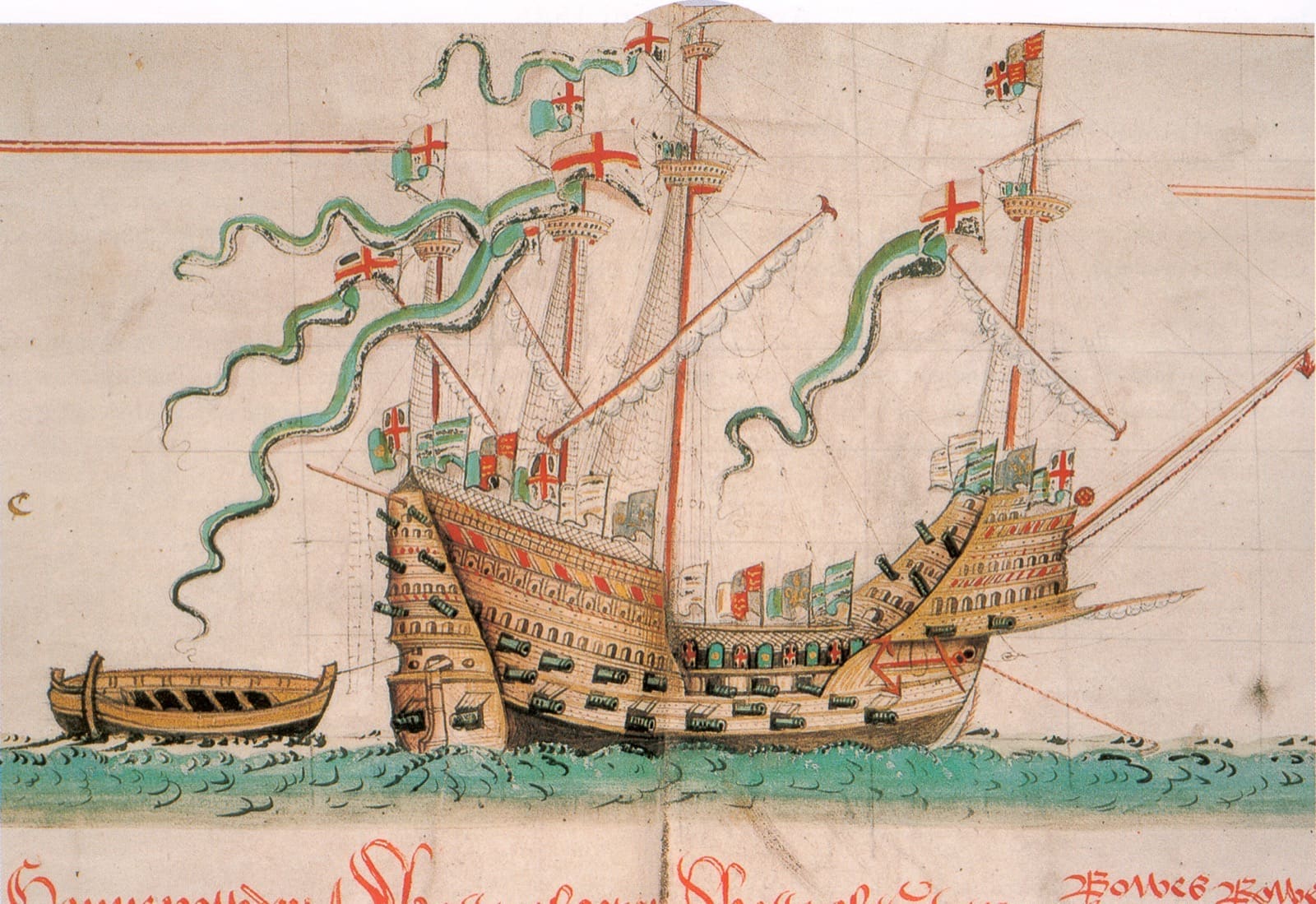
On July 19, 1545, a French fleet sat off the Isle of Wight and English ships came out of Portsmouth to meet it. Henry VIII was ashore at Southsea Castle, close enough to watch.
He watched the Mary Rose go over.
She was not hit by a broadside or rammed. She turned, heeled, took water through her open gunports and sank in the Solent. Of roughly 400 men aboard, fewer than 35 escaped. The vice-admiral commanding her, Sir George Carew, was not among them.
The king saw his ship sink a short row from the beach, and nobody has fully agreed on why ever since.
A 34-year-old ship with a lot of new weight
The Mary Rose was not new. She was laid down in 1510 and launched in 1511, one of the first big warships of Henry’s reign. By 1545 she had been in service for more than three decades.
She had also been rebuilt. Around 1536 she came out of a refit heavier, at an estimated 700 to 800 tons against roughly 500 when built. By 1545 she carried somewhere between 78 and 91 guns, counting the small ones. Heavy guns on a lower deck meant gunports cut low in the hull, close to the waterline.
That is the setup. Big guns, low ports, more weight than her builders had planned for.
The turn
The most widely accepted account goes like this. The Mary Rose fired the guns on one side at the French galleys and began to turn to bring the other side to bear. A gust caught her. She heeled over, and the sea came in through the open ports on the low side.
Once a ship heels far enough for water to pour through her gun deck, the weight of that water pushes her over further. There is not much time after that.
Then there is the Carew story. According to Sir Peter Carew, his uncle Sir Gawain Carew was sailing nearby and saw the Mary Rose start to heel. He called across to ask what was wrong. Sir George Carew shouted back that he had “the sort of knaves whom he could not rule.”
That is the vice-admiral, in the last minutes of his life, blaming the crew. Whether the crew failed him or he failed the crew, nobody survived from the quarterdeck to argue either way.
The competing explanations
The French had their own version. Their accounts claimed the galleys’ guns sank her. English sources say nothing of the kind, and most historians give the French claim little weight.
Other explanations pile up beside it:
- A gust of wind at the wrong moment in the turn.
- Gunports cut too low, left open during a maneuver.
- A crew that did not follow orders, or did not understand them.
- A ship made top-heavy by years of added guns and weight.
These are not really rival theories. Most of them can be true at once. A heavy old ship with low open ports, turning sharply in a gust, with a crew its captain could not control, does not need a French cannonball.
The Swedes found out the same thing 83 years later. Vasa sank in Stockholm harbor in 1628 when a gust pushed her over and water came through her open lower gunports. Same failure, same bad timing, in front of a crowd. Weight carried too high is an old enemy, and it was still catching navies in the 1940s, as the US Navy found with its Cleveland-class cruisers.
What the silt kept
Part of the hull settled into the silt of the Solent, and the silt sealed it.
That is why she is worth more to historians than a ship that survived. A ship that comes home gets emptied, repaired and broken up. A ship that sinks in a few minutes keeps everything the crew had on them when she went down.
Over 19,000 objects came up from the wreck site. Among them were more than 130 longbows, along with arrows, guns, tools, dice, backgammon sets, fiddles and casks of salted beef bones.
They also found the crew. The remains of at least 179 men were recovered.
In 2021, researchers published a multi-isotope study of eight of them. Isotopes in teeth and bones record where a person grew up and what they ate as a child. Five of the eight looked like western Britain. Up to three looked like somewhere warmer and further south, possibly southern Europe or North Africa.
One of them, nicknamed the Royal Archer, wore a leather wristguard carrying symbols linked to Moorish Spain. Another, the ship’s carpenter, may have had Iberian or North African origins; Spanish adzes were found in his cabin. A young man known as the Young Mariner had a skull shape suggesting African ancestry, though his teeth pointed to a childhood in south-west Britain. The researchers called it the first direct evidence for mariners of African descent in Henry VIII’s navy.
Henry’s warship, it turns out, did not have an all-English crew.
The smallest crew member was found in 1981 by divers working near the carpenter’s cabin, partly outside it and partly inside, under chests belonging to the carpenter and the gunners.
It was a dog. The excavators named him Hatch.
For years he was assumed to be female, because no penis bone was found. DNA analysis later showed Hatch was a young male, brown-coated, most closely related to the modern Jack Russell terrier. He also carried a gene for hyperuricosuria, a condition that can cause bladder stones. Most likely he was aboard to kill rats.
Where she is now
The Mary Rose Trust raised the surviving hull on October 11, 1982, after 437 years on the bottom.
Today the hull stands in the Mary Rose Museum at Portsmouth Historic Dockyard, a few miles from where she sank. Hatch’s skeleton is on display there. So are the longbows, the wristguard and the carpenter’s tools. A short walk away is HMS Victory, which carried Nelson’s body home from Trafalgar in a cask of brandy.
If you stand on Southsea Castle’s walls and look out over the Solent, you are roughly where Henry VIII stood on July 19, 1545. The water still looks calm from there.
Sources
- Mary Rose (Wikipedia)
- Diversity aboard a Tudor warship: investigating the origins of the Mary Rose crew using multi-isotope analysis (Royal Society Open Science, via PMC)
- Mary Rose dog was a he, not a she (ScienceDaily, 2014)
- Mary Rose (World History Encyclopedia)
- 13 facts about the Mary Rose (History UK)